

Looking Back, Looking Forward: A Personal Reflection on Our Past and What It Means for Today’s UNA-GP Members
By Christiaan Morssink, President, United Nations Association of Greater Philadelphia
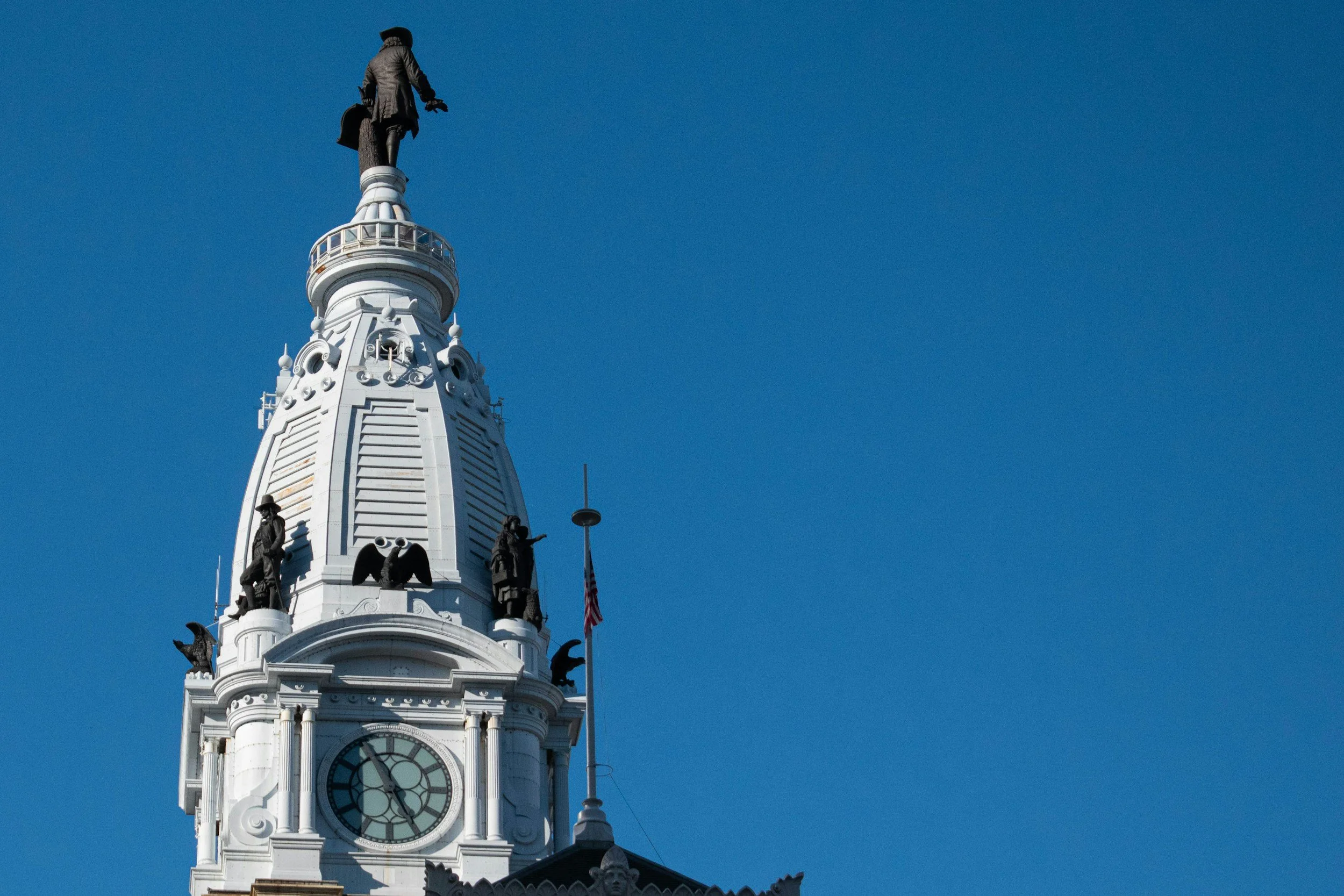
Philadelphia City Hall, Unsplash
When I look back at the long trajectory of the United Nations Association of Greater Philadelphia (UNA-GP), I am reminded that institutions—much like the people who sustain them—have lifecycles. They surge with energy, they pause, they reawaken, and they evolve. Our chapter, now more than fifty years old, embodies that rhythm. And as we begin this new chapter of communication with our community, I want to offer a reflection on where we came from, why we are here today, and what it means for all of us who carry the mission forward.
Somewhere in my files, I still have the original IRS document showing that the United Nations Association of Greater Philadelphia was officially registered as a nonprofit organization in 1972. Like many community-driven organizations, the chapter experienced periods of dormancy; the late 1980s and early 1990s were quiet years, when momentum waned and participation declined. Yet the ideals of the United Nations—cooperation, dignity, human rights, peace—never vanished from Philadelphia. They simply awaited the next generation of dedicated Philadelphians to bring them back to life.
The Revival: A New Chapter in the Late 1990s
The spark returned in the late 1990s, when Joan Reivich and Mike Felker spearheaded the local effort for the international Adopt-A-Minefield Campaign—an ambitious global initiative to raise funds and public awareness for clearing landmines around the world. Their work aligned with a broader international movement that was gaining extraordinary momentum; in 1997, the International Campaign to Ban Landmines (ICBL) received the Nobel Peace Prize.
At that time, David Eldridge, a respected professor at Haverford College, stepped into leadership as president of the UNA-GP. His involvement helped guide the chapter toward its modern form, with a strong emphasis on education, public engagement, and partnerships. The revival was not accidental—it grew from a constellation of community energies that converged at just the right moment.
It is also important to note the Quaker connection, which has long been woven into Philadelphia’s identity. The peace-centered philosophy of the Quaker community influenced both global activism, such as the ICBL, and local initiatives that fed into our chapter's revival. That legacy continues to influence our culture today: reflective, justice-oriented, collaborative, and grounded in the belief that peace is practical—not abstract.
Communities That Shaped Us
The UNA-GP has always been enriched by diverse groups who have contributed their passion and expertise. Many of our earliest partners in the revitalized chapter came from:
Unitarian Universalist congregations
Project for Nuclear Awareness
The Global Educators Movement
Peace Corps alumni
Immigrant communities across the region
Academics and students from Philadelphia’s colleges and universities
We worked shoulder-to-shoulder with professionals from the Philadelphia Bar Association and educators from the Philadelphia School District. Our activities often found a home at the Friends Center, where our office helped anchor us in the heart of the city’s civic and peace-building networks.
Over the years, we collaborated with organizations such as:
Citizens Diplomacy International
The Pennsylvania Immigration and Citizenship Coalition (PICC)
The Welcoming Center
Philadelphia Citizens for Children and Youth (PCCY)
PaCIE
Rotary International
The Global Water Alliance
Harmony for Peace Foundation
These partnerships strengthened our role as a connector—an organization that brings people, ideas, and missions together in the spirit of global citizenship.
Our Place in the UNA-USA and the Global Mission
As a chapter of the United Nations Association of the USA (UNA-USA), we are part of a national network of chapters—some large, some small—all committed to strengthening the relationship between the United States and the United Nations. Over the years, UNA-USA underwent a major transformation when it became part of the Better World Fund of the UN Foundation. This new structure brought more cohesion, strategic direction, and resources to the movement.
For us in Philadelphia, this means that while we maintain our local character and priorities, we also align with national guidance regarding advocacy, policy engagement, and programming. We operate at the intersection of global mission and local relevance, helping our community understand how the issues debated at the UN shape daily life in Philadelphia—and how Philadelphians can shape the global conversation in return.
In a post-COVID world, this mission is more important than ever. Our chapter has deepened its focus on recruitment, outreach, and education. We emphasize that being a Philadelphian, a resident of a city known for “brotherly love and sisterly affection,” naturally expands to being a citizen of the world. The values are connected. The responsibilities overlap. Our youth programs, Model UN initiatives, and campus recruitment efforts all reflect this belief.
Education as a Core Mission: Cultivating Global Citizens
One of the strongest threads throughout our history is our dedication to youth engagement and global education. The UNA-GP has always made it a priority to bring young people into dialogue with the United Nations—literally and figuratively.
Under the leadership of former UN Secretary-General Ban Ki-moon, the UN dramatically increased its outreach to young people and to scientists, recognizing that the future of global cooperation depends on both. We have mirrored that approach locally. Through Model United Nations conferences, school partnerships, water diplomacy programs, and human rights education, we give students the tools to understand not only the world’s problems, but also their own power to influence solutions.
Global citizenship is not a slogan; it is an educational journey. Our programs help students explore issues such as:
Human rights
Water security and justice
Climate and sustainability
Cultural identities and migration
Peacebuilding and diplomacy
Food access and hunger
Public health and science-based policy
These are not abstract themes; they are the lived experiences of communities worldwide and in our own city. Each event, workshop, and partnership invites young people to look outward and inward—to see themselves as part of a global effort to build a just, sustainable future.
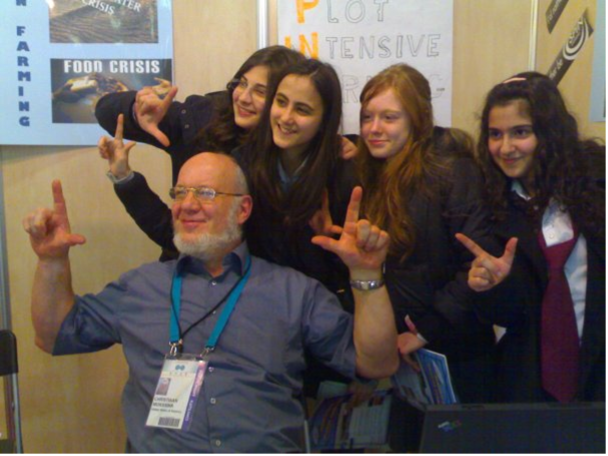
Crossing Borders, Crossing Generations
One of my most cherished memories comes from 2009, when a group of our high school students joined me at a session of the World Water Forum. We were discussing new approaches to sustainable agriculture, hunger reduction, green technologies, and equitable water management. After the session, the students posed for a photo—smiling, energized, and flashing the LABAN sign, a gesture popularized by Corazon Aquino during the people’s movement in the Philippines.
That image captures so much of what the UNA-GP stands for. Borders were crossed: geographic borders, generational borders, and borders of experience. And the symbol itself—LABAN, meaning “fight”—reminds us of what we fight for:
Freedom of expression
Freedom of thought
Freedom to associate
Freedom to share in the joy and dignity of humanity
These freedoms are at the heart of the UN’s mission, and they continue to guide our work here in Philadelphia.
What This Means for Us Today
As we step forward into the next stage of our chapter’s history, I want our new and returning members to know that they are part of a long story—one shaped by volunteers, advocates, educators, immigrants, youth leaders, and global thinkers. Our work is not new, but it is continually renewed by the people who step forward.
Today, the UNA-GP stands on three strong pillars:
Youth Engagement: Empowering young people to lead, question, innovate, and advocate.
Global Education: Helping Philadelphians understand the UN’s work and how it connects to their lives.
Community Partnerships: Building bridges across institutions, neighborhoods, professions, and cultures.
The challenges facing the world today—from climate change to displacement, from public health crises to conflicts—require informed, compassionate, globally aware citizens. That is our mission. That is our legacy. And that is where you come in.
Looking Forward With Purpose
I hope that this first blog post serves as both a welcome and an invitation. Our history shows that when Philadelphians organize around global issues, real change happens—locally and internationally. The UNA-GP is not just an organization; it is a community of people who believe that a better world is possible and that our city has a meaningful role to play in achieving it.
As we move forward, let us continue to learn from our past, honor the people who built this chapter, and create new pathways for those who will inherit it. The work of global citizenship is never finished—but it is always shared.
Thank you for being part of this journey. The future of the UN’s mission—and our global community—rests in the hands of all who choose to engage, to learn, and to work for a more just and peaceful world.
